Our story
It started with a 3 that should have been a 5
Torquenote is a physics teacher, two graders and a lot of red ink. We write the solutions graders want to read, because we have spent years being the graders.
 A spinning top stays up because of angular momentum. Unit 6.
Ava knew the physics. The rubric never saw it.
In 2021 Nathan was tutoring a junior from Austin who could solve anything he put in front of her. She got a 3. When the scores came back he asked her to redo the free responses from memory, and the problem was obvious within minutes: correct answers, no free-body diagram, no integral written out, no sentence of justification.
The AP rubric gives points for ideas you put on paper. Ava had done the ideas in her head. So Nathan wrote out forty of her problems the way he would want to grade them, step by step, with a red note next to each line that earns a point.
Those forty pages became Moment Arm. Ava took them to her physics class; by September, Nathan was getting emails from students he had never met.
Sixteen years of red ink, in six dates
From a classroom in Ohio to a desk in Lyon that ships PDFs to students in every time zone of the US.
2010
Nine years at the front of a physics classroom
Nathan Keller starts teaching AP Physics C at a public high school in Columbus, Ohio. By the end he has read close to four thousand free responses from his own students, red pen in hand.
2019
Lyon, and the evening tutoring shift
He moves to Lyon for family reasons and teaches at an international school. Lyon evenings are American afternoons, so he keeps tutoring AP students online after dinner.
2021
The 3 that should have been a 5
Ava, a junior he tutors, understands every problem and still gets a 3. Her answers are right, but the lines the rubric scores are missing. That summer Nathan rewrites her 40 weakest problems the long way. The PDF goes around her class within a week.
2022
Moment Arm, the first book
Torque was the unit his students feared most, so it came first. The name of the shop comes from the same place: a torque, and the note you write next to it.
2024
Two graders join, every book is rewritten
Priya Raman and Tom Becker, both former physics teachers, start checking every solution. The course framework changes to seven units, and all the books are rebuilt around them.
2025
The grading desk opens
Students start sending photos of their own answers. Each one comes back scored line by line within 72 hours, which became the Exam Season Pass.
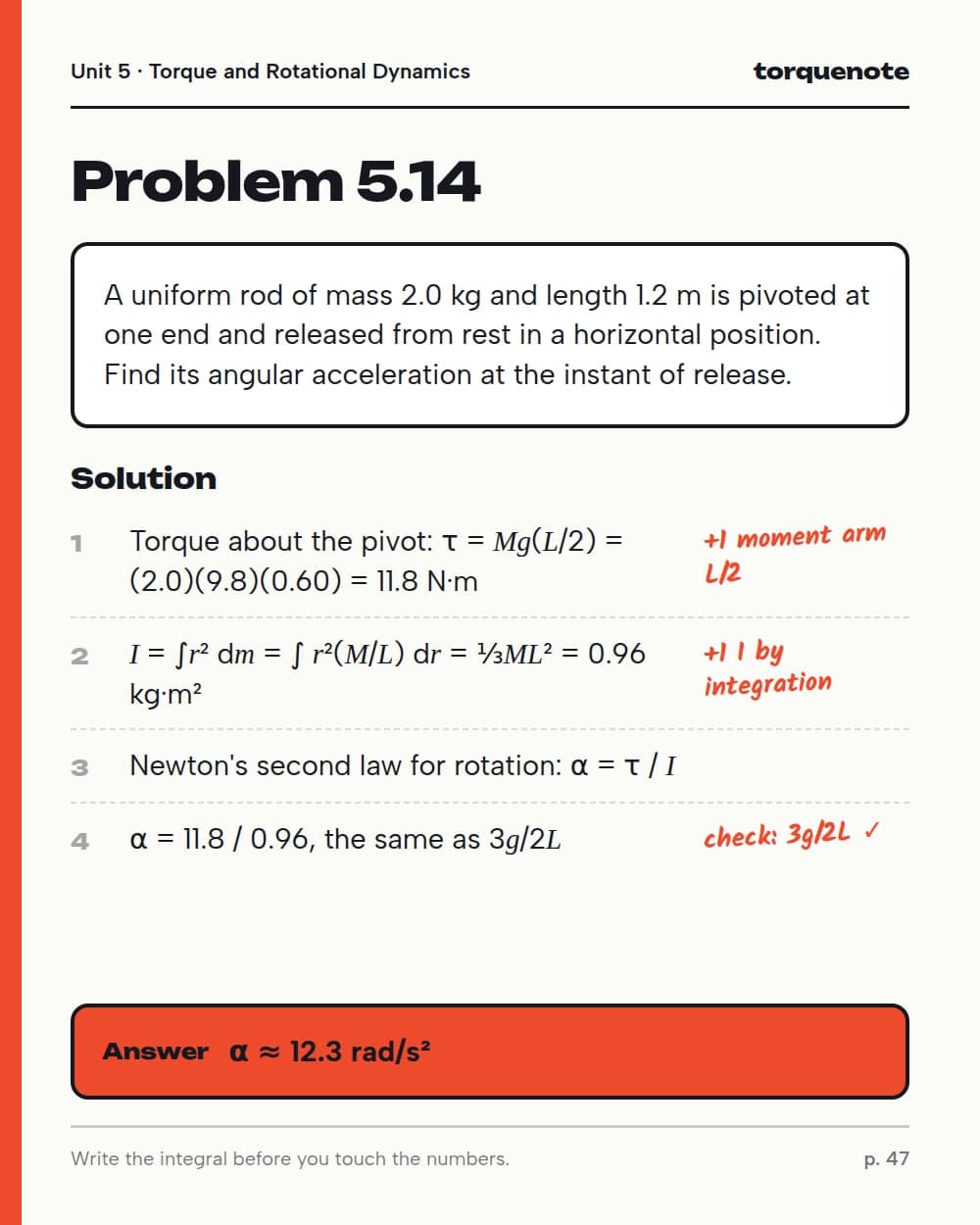
Every solution is solved twice before it ships
- Written
- Nathan writes each problem from the learning objectives of its unit, then solves it with the calculus on the page.
- Solved again
- Priya or Tom solves it a second time without looking. If the two solutions disagree, the problem is rewritten.
- Marked
- The red notes show which line earns which point, using the same logic as the published scoring guidelines.
- Revised in June
- After each exam we read the released questions and update the books. Buyers get the new edition by email.
Three teachers read every page you buy
Nathan Keller
Founder, writes the books
Taught AP Physics C in Ohio for nine years. Now in Lyon, still tutoring four evenings a week.
Priya Raman
Grader, mechanics and FRQs
Former physics teacher in New Jersey. Scores most of the answers sent to the grading desk.
Tom Becker
Grader, labs and experimental design
Taught physics and engineering in Colorado. Checks every lab question and every graph.